

Structural Icing, Ice Crystal Icing & Pitot Icing: What’s the Difference?
Ice on the wings. Ice inside an engine. Ice blocking a pitot tube. They all sound like “aircraft icing.” But in aviation, they describe very different hazards.
In this episode, we’re answering a question that even many experienced aviation enthusiasts get wrong: what’s the real difference between structural icing, ice crystal icing, and pitot icing? Choosing the wrong term could mean describing the wrong event during your ICAO Language Proficiency Test.
We’ll break down each hazard individually, walk through a real-world case study involving Air Algérie Flight AH5017, and close with six essential expressions to boost your Aviation English vocabulary.
Hello aviators, and welcome back. This is Episode 19 of Aviation English by Revise Before Flight, called “Structural Icing, Ice Crystal Icing & Pitot Icing, What’s the Difference?” Let’s break them down.
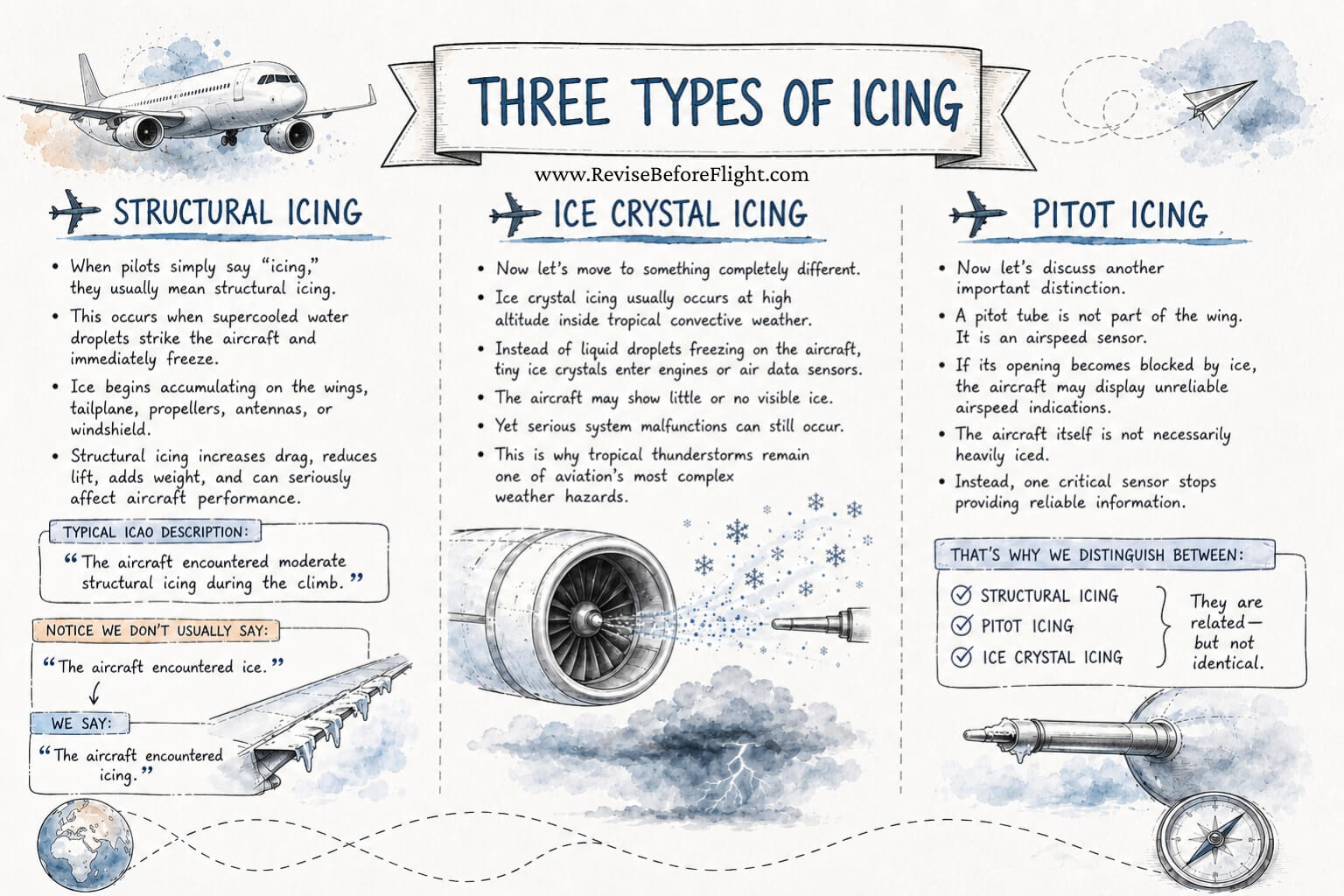
Structural Icing
When pilots simply say “icing,” they usually mean structural icing. This occurs when supercooled water droplets strike the aircraft and immediately freeze. Ice begins accumulating on the wings, tailplane, propellers, antennas, or windshield.
Structural icing increases drag, reduces lift, adds weight, and can seriously affect aircraft performance. A typical ICAO description would be, “The aircraft encountered moderate structural icing during the climb.”
Notice we don’t usually say, “The aircraft encountered ice.” We say, “The aircraft encountered icing.”
Ice Crystal Icing
Now let’s move to something completely different. Ice crystal icing usually occurs at high altitude, inside tropical convective weather. Instead of liquid droplets freezing on the aircraft, tiny ice crystals enter engines or air data sensors.
The aircraft may show little or no visible ice, yet serious system malfunctions can still occur. This is why tropical thunderstorms remain one of aviation’s most complex weather hazards.
Pitot Icing
Now let’s discuss another important distinction. A pitot tube is not part of the wing, it is an airspeed sensor. If its opening becomes blocked by ice, the aircraft may display unreliable airspeed indications.
The aircraft itself is not necessarily heavily iced. Instead, one critical sensor stops providing reliable information. That’s why we distinguish between structural icing, pitot icing, and ice crystal icing. They are related, but not identical.
Case Study: Air Algérie Flight AH5017
A well-known example occurred during Air Algérie Flight AH5017. While flying near intense tropical convection, the aircraft experienced unreliable airspeed after the pitot system was affected by ice crystals.
The autopilot disconnected, increasing cockpit workload. The subsequent investigation showed that the accident involved far more than weather alone. It demonstrated how multiple technical and human factors can align within seconds.
ICAO Boost: Six Key Expressions
Here are six expressions worth adding to your Aviation English.
1. Unreliable airspeed – Incorrect or conflicting airspeed indications. “The crew carried out the Unreliable Airspeed procedure.”
2. Supercooled water droplets – Liquid water below freezing temperature. “Supercooled droplets froze immediately on contact.”
3. Convective weather – Weather associated with vertical air movement. “The crew requested a deviation around convective weather.”
Professional Insight
One of the easiest ways to sound like an ICAO Level 5 or 6 speaker is not by using more vocabulary, but by using more precise vocabulary.
Instead of saying, “There was ice,” say, “The aircraft encountered moderate structural icing.” Instead of saying, “The speed instruments failed,” say, “The crew experienced unreliable airspeed following pitot probe obstruction.”
Specific language reflects specific understanding, and that’s exactly what ICAO examiners are listening for.
Recap
Today’s lesson reminds us that not all icing is the same. Structural icing affects the aircraft. Pitot icing affects the sensors. Ice crystal icing affects systems operating at high altitude near powerful thunderstorms. Knowing the difference won’t just improve your Aviation English, it will make your operational descriptions far more precise.
If you’d like to reinforce today’s lesson, visit my website and check out the blog post with the same title as this episode. You’ll find clear illustrations that show the differences between structural icing, pitot icing, and ice crystal icing, making these concepts even easier to understand and remember.
Until next time, keep your terminology accurate, your weather awareness high, and your communication professional. Clear skies, aviators.

Leave A Comment