

Skybound Dictionary: High vs. Tall
A tall building. A high mountain. A tall tower. A high altitude. If you’ve ever hesitated between these two words, you’re not alone. They can both describe vertical dimensions, but they focus on different things.
In this episode, we’re launching a new shorter spin-off series, the Skybound Dictionary, where we explore confusing words and word groups one aviation English topic at a time. Today we’re looking at high versus tall.
Listen to “23. High versus Tall – The Skybound Dictionary” on Spreaker.
The Core Rule
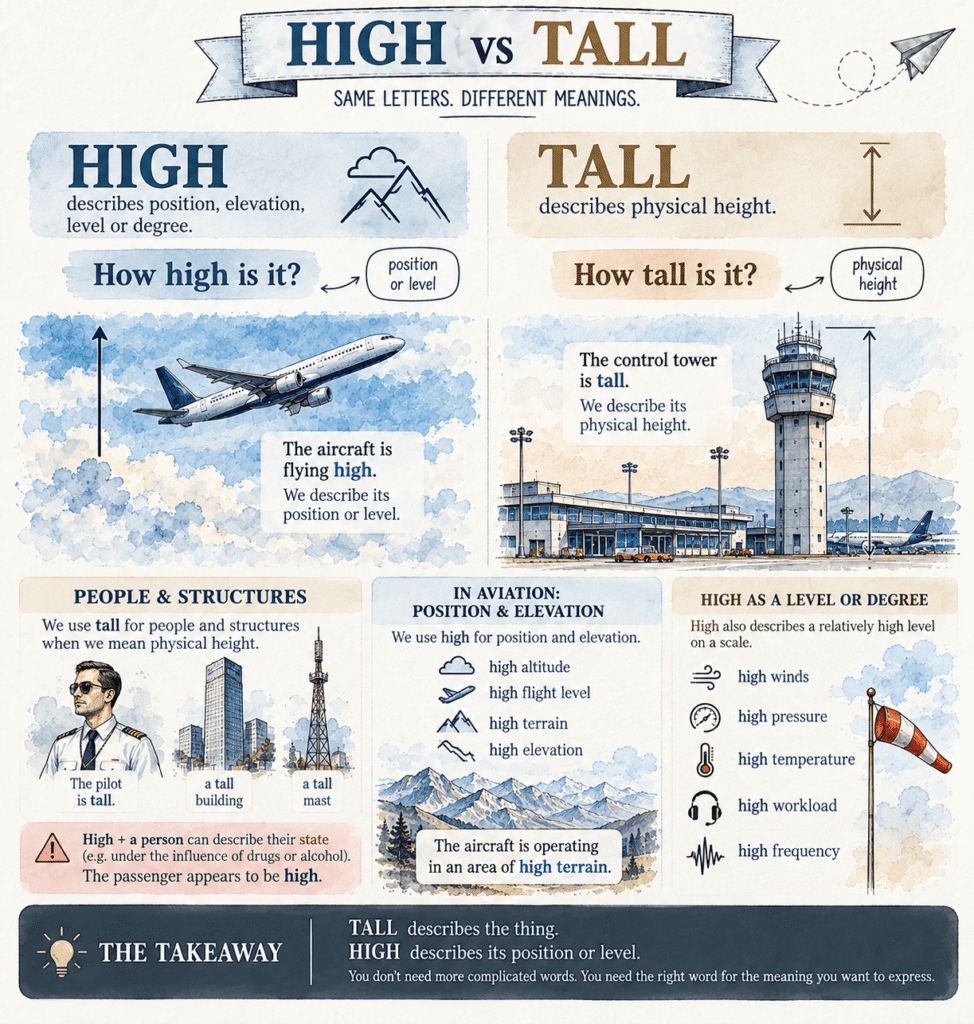
The simple rule here is the distinction. Tall describes physical height. High describes position, elevation, level, or degree. So we ask “how tall is it?” for physical height, and “how high is it?” for position or level.
For example, the control tower is tall, we’re describing the tower’s physical height. And the aircraft is flying high, we’re describing its position. That’s the basic distinction.
People and Structures: Using “Tall”
For people, we normally use tall when we’re talking about physical height. “The pilot is tall.” “She’s a tall woman.”
But there is an important meaning difference worth remembering in passenger-related communication. “High” plus a person can describe someone who appears to be intoxicated, particularly under the influence of drugs or alcohol. For example, “The passenger appears to be high.” Here, high describes the person’s state, not their physical height. It’s a small distinction, but one worth knowing in aviation communication.
For physical height, we use tall not only for people, but also for structures: a tall building, a tall tower, a tall mast, a tall antenna. So the focus is always on the physical height of the person or object.
Position and Elevation: Using “High”
Now, we fly high in aviation. High is especially useful for position and elevation: high altitude, high flight level, high terrain, high elevation.
For example, “The aircraft is operating at a high altitude,” or “The aircraft is approaching an area of high terrain.” We’re talking about where something is, or how elevated it is.
High as a Level or Degree
High has another job, and here is the useful part. High can also describe a level or degree on a scale: high winds, high pressure, high workload, high temperature, high frequency.
Nothing here is about physical height. High simply tells us that something is at a relatively high level.
A useful aviation pattern is with terrain at elevation. High is the natural aviation choice: high terrain, a high mountain, a high peak, high elevation. This is why you’ll often hear, “The aircraft is operating in an area of high terrain.”
Skybound Boost: Build Your Vocabulary
So let’s build your aviation vocabulary around these two words.
Tall, physical height: a tall tower, a tall mast, a tall building.
High, position, elevation, or level: high altitude, high terrain, high flight level, high workload, high winds.
And remember the two questions: “How tall?” for physical height. “How high?” for position, elevation, or level.
Recap
The takeaway: tall describes the thing. High describes its position or level. That’s all you need to remember. And that’s the beauty of precise Aviation English, you don’t need more complicated words, you need the right word for the meaning you want to express.
And that’s today’s Skybound Dictionary: High vs. Tall. For the visual version of today’s lesson, check out the accompanying post on RevisebeforeFlight.com. And if there’s another aviation English word pair that makes you hesitate, send me your suggestion at emilia@revisebeforeflight.com, it might become our next episode.
Until next time, keep your vocabulary precise, your choices confident, and your Aviation English professional. Clear skies, aviators.


Leave A Comment