

ICAO Booster #1: How to Describe Turbulence Precisely
Turbulence is one of those things pilots deal with all the time. Sometimes it’s barely noticeable, sometimes it’s a reason for periodic illumination of the seatbelt sign. And sometimes it becomes a genuine operational concern. So how do you describe those different situations accurately in Aviation English?
✈️ Want today’s turbulence vocabulary in one place?✈️ Download the PDF and start using these expressions in your next flight briefing. Just click the thumbnail below 👉

In this episode, we’re launching a new series: ICAO Booster, short episodes focused on one specific area of language that can help you make your operational English more precise. Today’s situation is something pilots and passengers encounter regularly, turbulence, because turbulence can be routine, but sometimes it becomes an operational concern. Let’s look at how professional pilots describe that change.
Listen to “21. How To Describe Turbulence Precisely – ICAO Booster 1” on Spreaker.
Hello, aviators, and welcome back to my 21st podcast episode, “ICAO Booster #1: How to Describe Turbulence Precisely.”
Part 1: Grammar on the Radar
Turbulence can be a routine occurrence during a flight, but it can also become a non-routine operational event, and our language needs to reflect that difference.
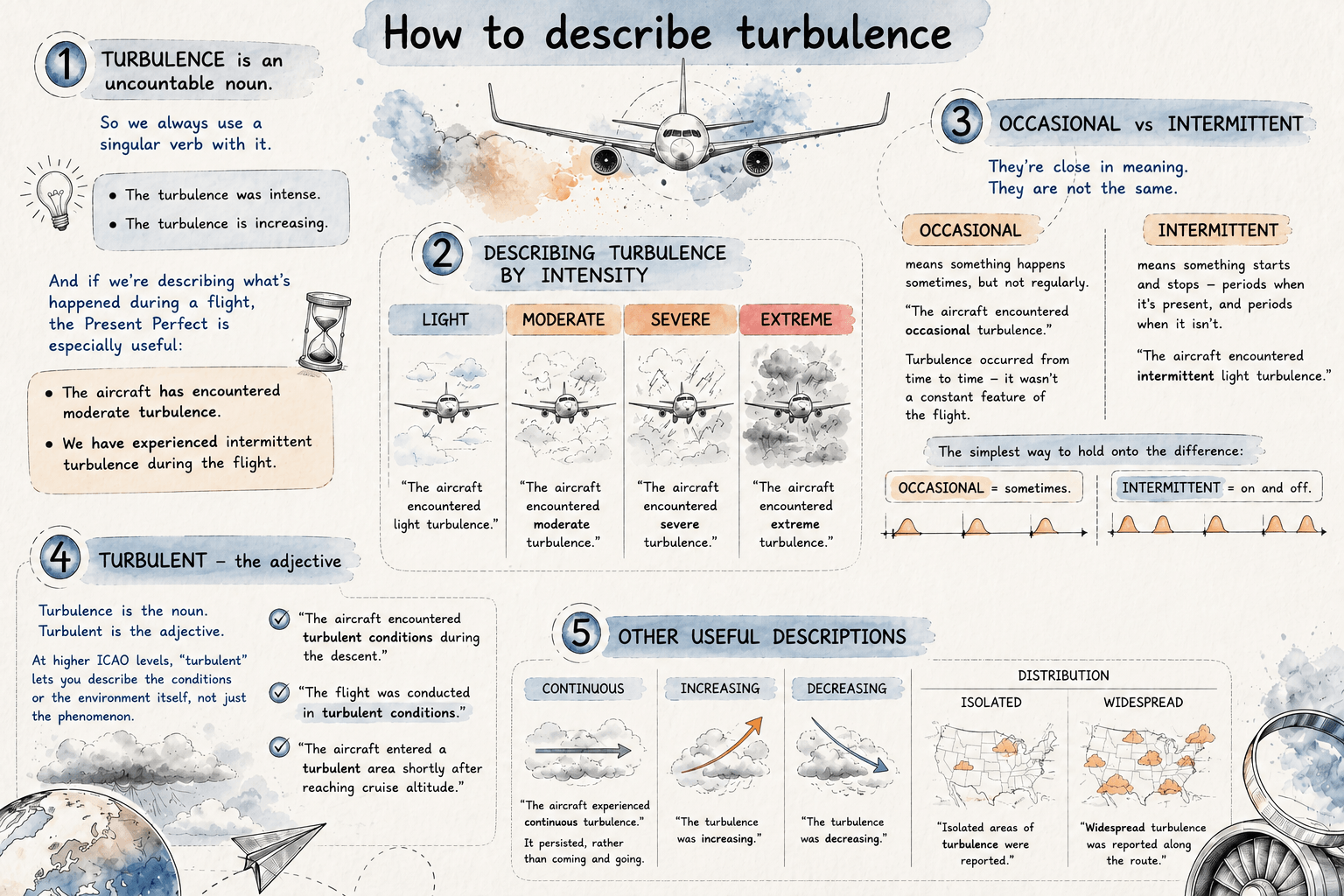
Let’s start with the word itself. Turbulence is an uncountable noun, so we always use a singular verb with it. “The turbulence was intense.” “The turbulence was increasing.”
If we’re describing what has happened during a flight, the present perfect is especially useful. “The aircraft has encountered moderate turbulence.” “We have experienced intermittent turbulence during the flight.” The present perfect works well here because it links a past event to its relevance right now, exactly the kind of link ATC and dispatch need.
And if you want to talk about separate areas or encounters, you can make the expression countable: “The aircraft has encountered several areas of turbulence.”
So remember, turbulence is uncountable. That one distinction unlocks several precise structures: “The turbulence was intense.” “The turbulence is increasing.” “The aircraft has encountered moderate turbulence.” “The aircraft has encountered several areas of turbulence.” A small grammar point, but a very useful one for precise operational communication.
Part 2: Same Family, New Call Sign, Turbulence and Turbulent
There’s another useful word from the same family: turbulent. Turbulence is the noun. Turbulent is the adjective. At higher ICAO levels, you can use “turbulent” to describe the conditions or environment.
For example: “The aircraft encountered turbulent conditions during the descent.” “The flight was conducted in turbulent conditions.” “The aircraft entered a turbulent area shortly after reaching cruise altitude.”
Notice the difference between “the aircraft encountered moderate turbulence” and “the aircraft encountered turbulent conditions.” Both are correct, but they give us slightly different ways of describing the situation. Turbulence identifies the phenomenon. Turbulent describes the conditions.
Part 3: On the Gauge, Light to Extreme
Now let’s move to our core vocabulary. We can describe turbulence according to its intensity:
Light – “The aircraft encountered light turbulence.”
Moderate – “The aircraft encountered moderate turbulence.”
Severe – “The aircraft encountered severe turbulence.”
Extreme – “The aircraft encountered extreme turbulence.”
These words describe intensity, and that’s an important distinction. You don’t need a more complicated noun. You don’t need a longer sentence. You simply need the right adjective.
Part 4: Blips on the Radar, Occasional or Intermittent
Now let’s look at two words that can be confusing: occasional and intermittent. They’re similar, but they are not exactly the same.
Occasional means that something happens, but not regularly or frequently. For example: “The aircraft encountered occasional turbulence.” In other words, turbulence occurred from time to time, but it wasn’t a constant feature of the flight.
Intermittent means that something starts and stops, with periods when it is present and periods when it is not. For example: “The aircraft encountered intermittent light turbulence.”
Here is a simple way to remember the distinction: occasional tells you how often, intermittent tells you how it happens. Think of intermittent fasting, you eat between nine and five, then you stop. The next day, you eat again between nine and five. Eating, not eating, eating, not eating. On, off, on, off. That’s intermittent. So when you hear “intermittent light turbulence,” picture that same pattern: turbulence, calm, turbulence, calm, starting and stopping.
We can also describe turbulence as continuous: “The aircraft experienced continuous turbulence,” meaning the turbulence persisted rather than occurring only occasionally. We can describe it as increasing or decreasing: “The turbulence was increasing.” “The turbulence was decreasing.” And we can describe its distribution as isolated or widespread: “Isolated areas of turbulence were reported.” “Widespread turbulence was reported along the route.”
Again, we’re not trying to collect impressive vocabulary. We’re choosing words that tell the listener what was actually happening.
Part 5: Straight From the Black Box: A Real-World Case Study
Now let’s bring in a real example: the United Airlines Flight 115 event from March 29, 2026. A Boeing 787-9 flying from San Francisco to Papeete, Tahiti, with 151 passengers and 12 crew on board.
One flight attendant was seriously injured. No passengers were hurt, and the aircraft landed safely, where paramedics met it on arrival. The NTSB opened an investigation and classified it as a turbulence encounter in their report released on August 21, 2026.
According to the report, the aircraft encountered turbulence while in cruise flight at flight level 300, en route to Faa’a International Airport in Tahiti. The report describes the first part of the flight as intermittent light turbulence. That’s a beautiful example of how two adjectives give us considerably more information, not simply “there was turbulence,” but “the airplane encountered intermittent light turbulence.”
The report also tells us that this resulted in periodic illumination of the seatbelt sign. That’s another useful operational expression. Instead of “the seatbelt sign kept coming on,” we have “periodic illumination of the seatbelt sign.” Notice how aviation reports turn a relatively ordinary event into a precise operational description.
Then, approximately 95 minutes after departure, the aircraft encountered something different. The report describes a jolt of moderate clear air turbulence. That’s another excellent expression to add to your Aviation English toolbox. A jolt of turbulence describes a sudden, pronounced movement or disturbance, and clear air turbulence (CAT) describes turbulence occurring in apparently clear air, without visual indications associated with convective weather.
So compare “the aircraft experienced turbulence” with “the aircraft encountered a jolt of moderate clear air turbulence.” The second description tells us much more: what happened, how intense it was, and what type of turbulence it was. That’s the kind of precision we’re looking for.
Part 6: Cleared for the Flight Deck
Now I want to give you one phrase directly from the report. It’s longer, but extremely useful, because it combines timing, the operational event, and additional context: “At the time of the flight’s turbulence encounter, there were no active in-flight weather advisories or company-issued advisories for the area.”
You don’t have to reinvent this sentence every time. Learn it as a structure: “At the time of the flight’s [here comes the event], there were no [here you can describe the relevant conditions or share the information which is suitable for the area].” That’s a very different level of language from simply saying “there was turbulence.” You’re placing the event in its operational context, and that’s exactly what we want to develop at Level 5 and 6.
Part 7: On the Checklist: ICAO Level 5 and 6
1. Intermittent light turbulence – Turbulence that starts and stops, with periods when it is present and periods when it is not, at light intensity.
2. Periodic illumination of the seatbelt sign – The formal operational way of saying the seatbelt sign kept coming on. “This resulted in periodic illumination of the seatbelt sign.”
3. Jolt – Noun and verb. You’ve just heard it as a noun, but “jolt” also works as a verb in a turbulence context. “Turbulence jolted the aircraft.” “The aircraft was jolted by turbulence.” Same word, two roles.
The Command Voice (Professional Insight)
Professional Aviation English isn’t about sounding more advanced. It’s about making sure there is no room for misunderstanding.
Saying “it got bumpy” is not the same as reporting “intermittent light turbulence.” Saying “it was a rough patch” is not the same as describing “a jolt of moderate clear air turbulence.” The right word in the right place tells the listener exactly what happened, and exactly how seriously to take it.
Final Descent (Summary)
Today’s lesson reminds us that turbulence isn’t just one thing. It can be occasional or intermittent, light, moderate, severe, or extreme, isolated or widespread, steady or a sudden jolt. Understanding the difference won’t just improve your Aviation English, it’ll help you communicate accurately when every word matters.
If you’d like to reinforce today’s lesson, visit my website and read the blog post with the same title as this episode. You’ll find a practical visual summary on describing turbulence, plus the full NTSB report reference. The link is in the episode description.
And if you’d like more Aviation English resources, podcast updates, and exclusive learning materials, I’d love to welcome you to my Aviation English Logbook newsletter. You’ll find the sign-up link in the episode description as well.
I’ll also let you in on something I’m working on, a full grammar course launching by the end of 2026. In it, I’ll break down exactly what we covered today, “the turbulence was intense” versus “the aircraft has encountered several areas of turbulence,” the difference between those two structures, and why choosing the right one matters in real operational English. If that’s something you want to be the first to know about, the newsletter is where I’ll be sharing updates.
If you have a topic you’d like me to cover in a future ICAO Booster or full episode, Aviation English, ICAO phraseology, Skyborne Grammar, aviation safety, or anything else related to aviation, I’d love to hear from you. Send your ideas to emilia@revisebeforeflight.com. Your suggestions might become the inspiration for a future episode and help fellow aviators around the world improve their Aviation English.
Thank you for listening and being part of the Revise Before Flight community. Until next time, keep your phraseology precise, your description specific, and your communication professional. Clear skies, aviators.




Leave A Comment