

Minimum Fuel vs. Fuel Emergency: Aviation English Beyond the Checklist (AVA052)
“We’re minimum fuel.” “Mayday, fuel.” They both involve fuel. They both sound serious. But they don’t mean the same thing. Using the wrong phrase could cause confusion between the flight crew and air traffic control.
In this episode, we’re looking at two critical ICAO expressions, minimum fuel and fuel emergency. We’ll find out why those two phrases make a huge difference, walk through the tragic case study of Avianca Flight 052, and close with key vocabulary to sharpen your operational communication.
Before we begin, a quick note: this episode is not intended to create anxiety about flying. Fuel planning is one of the most carefully regulated parts of every flight. Commercial crews calculate fuel requirements long before departure and continuously monitor fuel consumption throughout the flight. The language I’ll discuss today exists to help pilots and controllers make safe operational decisions before a situation becomes critical.
Hello aviators, and welcome back to my twentieth podcast episode, “Minimum Fuel vs. Fuel Emergency: Aviation English Beyond the Checklist.”
Why Words Matter
Imagine you’re approaching your destination. Strong headwinds have increased fuel consumption. You’ve been placed in a holding pattern. Fuel is becoming a concern.
Should you say, “We’re minimum fuel”? Or should you declare, “Mayday, fuel”? The answer depends on the situation. These phrases are not interchangeable.
What Does “Minimum Fuel” Mean?
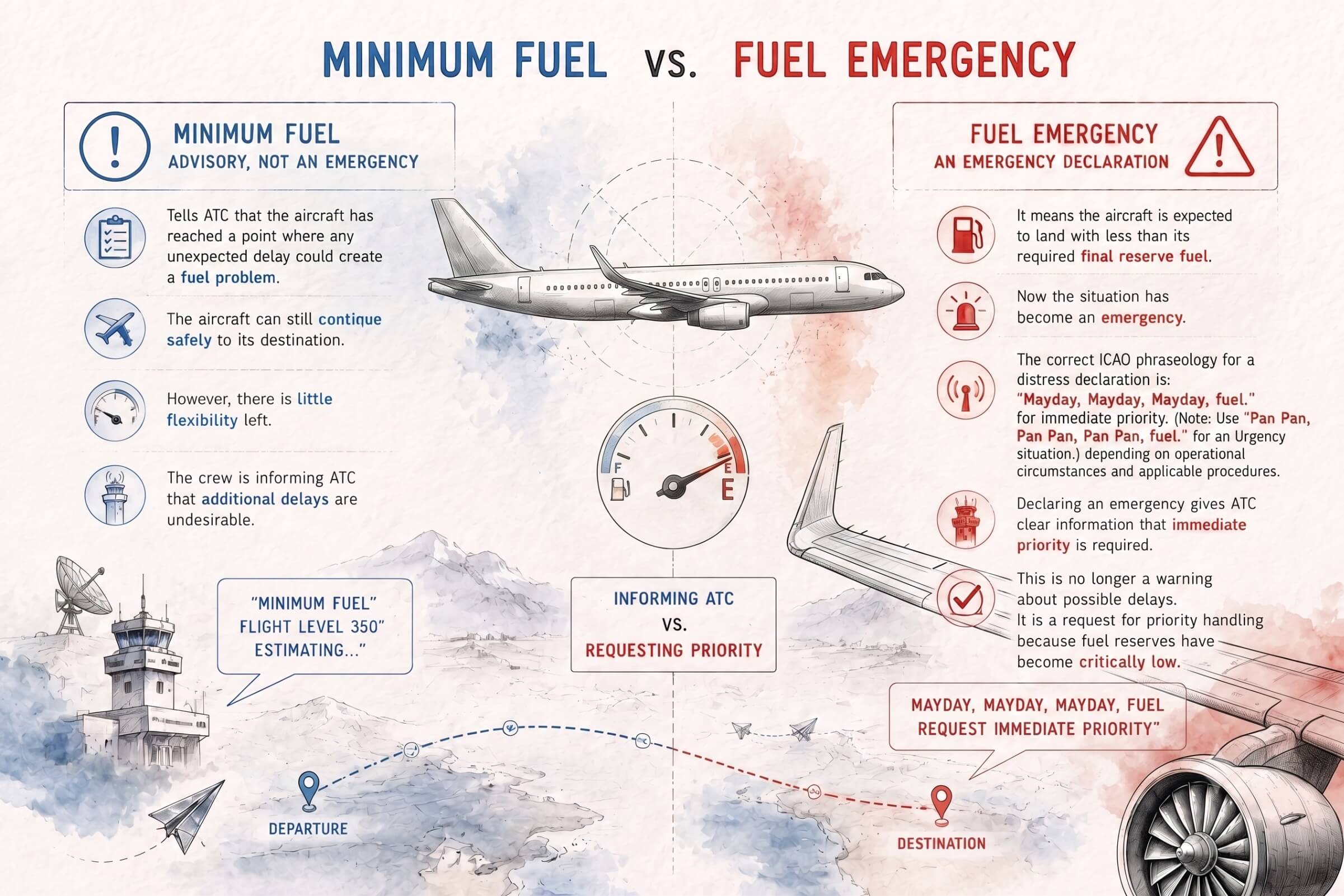
“Minimum fuel” is an advisory, not an emergency declaration. It tells ATC that the aircraft has reached a point where any unexpected delay could create a fuel problem. The aircraft can still continue safely to its destination. However, there is little flexibility left. The crew is informing ATC that additional delays are undesirable.
A typical ICAO transmission might be, “Minimum fuel,” or, “Approach, Speedbird 452, minimum fuel.” This tells ATC: “I can continue, but please avoid any unnecessary delay.”
What Is a Fuel Emergency?
A fuel emergency is very different. It means the aircraft is expected to land with less than its required final reserve fuel. Now the situation has become an emergency.
The correct ICAO phraseology is “Mayday, Mayday, Mayday, fuel,” or “Pan-Pan, Pan-Pan, Pan-Pan, fuel,” depending on the operational circumstances and applicable procedures.
Declaring an emergency gives ATC clear information that immediate priority is required. This is no longer a warning about possible delays. It is a request for priority handling because fuel reserves have become critically low.
Can Minimum Fuel Become an Emergency?
Absolutely. A flight may first report, “Minimum fuel.” Then, if unexpected delays continue, weather deteriorates, or another approach becomes necessary, the situation may worsen. At that point, the crew may declare, “Mayday, fuel.”
Minimum fuel is an early warning. A fuel emergency means the situation has already become critical.
Case Study: Avianca Flight 052
One of the most important fuel-related accidents in aviation history was Avianca Flight 052. On January 25, 1990, a Boeing 707 was flying from Bogotá to New York via Medellín. After delays caused by heavy traffic and poor weather around New York, the aircraft entered several holding patterns and flew multiple approach sequences, consuming far more fuel than planned.
Throughout the flight, the crew informed air traffic control that they were running low on fuel. However, they never explicitly declared a fuel emergency using internationally recognized emergency phraseology.
Eventually, all four engines lost power due to fuel exhaustion. The aircraft crashed on Long Island, killing 73 of the 158 people on board.
The investigation concluded that several factors contributed to the accident, but one of the most significant lessons was the importance of clear, unambiguous communication between pilots and air traffic controllers when fuel becomes critical.
What Changed After This Accident?
The crash of Avianca Flight 052 highlighted the importance of clear fuel-related communication between pilots and air traffic controllers. Although the crew repeatedly indicated that they were running low on fuel, they never explicitly declared a fuel emergency. As a result, ATC did not fully understand the urgency of the situation.
The accident led to important improvements in aviation safety. Pilots now receive much more comprehensive training on when to report “minimum fuel” and when to declare a fuel emergency using standard ICAO phraseology. Air traffic controllers are also trained to recognize these fuel-related calls immediately and to understand the operational implications of each one.
Fuel management has become a much greater focus during recurrent training and simulator sessions, with crews practicing scenarios involving holding patterns, diversions, unexpected delays, and deteriorating weather. Modern Flight Management Systems (FMS) also provide more accurate fuel predictions, helping crews identify developing fuel concerns earlier and make timely operational decisions.
The impact of Avianca Flight 052 extended far beyond fuel management. Although the accident did not directly lead to the creation of ICAO’s Language Proficiency Requirements, it became one of several major accidents that highlighted the potentially fatal consequences of ineffective pilot-controller communication. Together with other communication-related accidents, including the 1977 Tenerife disaster and the 1996 Charkhi Dadri mid-air collision, it reinforced the need for clearer operational communication and the consistent use of standard ICAO phraseology.
These lessons contributed to ICAO’s ongoing work on language proficiency, culminating in the introduction of mandatory ICAO Language Proficiency Requirements, with worldwide implementation beginning in 2008. By 2011, ICAO Doc 9835 and standardized language testing had become well established. The message remains as relevant today as ever: clear communication saves lives, and precise Aviation English is a fundamental part of global flight safety.
Key Language: ICAO Level 5-6
1. Final reserve fuel – The minimum amount of fuel that must remain after landing, according to regulations. “The aircraft was expected to land below final reserve fuel.”
2. Priority handling – Special ATC assistance provided to an aircraft requiring immediate attention. “ATC provided priority handling after the emergency declaration.”
3. Fuel monitoring – The continuous assessment of fuel quantity and fuel consumption throughout the flight. “The crew closely monitored fuel consumption during the diversion.”
Professional Insight
Professional aviation English isn’t about sounding more advanced. It’s about making sure there is no room for misunderstanding.
Saying “we’re getting low on fuel” is not the same as reporting “minimum fuel.” Likewise, saying “we’re almost out of fuel” is not the same as declaring “Mayday, Mayday, Mayday, fuel.”
Standard ICAO phraseology leaves no doubt about the operational situation, allowing air traffic controllers to respond appropriately and without delay.
Recap
Today’s lesson reminds us that minimum fuel is not an emergency. It is an advisory that additional delays cannot be accepted without increasing operational risk. A fuel emergency, however, means priority handling is required because fuel reserves have become critically low.
Understanding the difference won’t just improve your Aviation English. It will help you communicate accurately when every word matters.
If you’d like to reinforce today’s lesson, visit my website and read the blog post with the same title as this episode. You’ll find a practical visual summary on minimum fuel and fuel emergency, along with phraseology notes, in the episode description.
And if you’d like more Aviation English resources, podcast updates, and exclusive learning materials, I’d love to welcome you to my Aviation English Logbook newsletter. You’ll find the sign-up link in the episode description as well.
Before we finish, I’d like to say a special thank you to one of my followers, an ATC, whose list of topic suggestions inspired today’s episode. Thank you for taking the time to share your ideas and for being part of this learning community.
If you have a topic you’d like me to cover in a future podcast, whether it’s Aviation English, ICAO phraseology, grammar, aviation safety, or anything else related to aviation, I would love to hear from you. Send your ideas to emilia@revisebeforeflight.com. Your suggestion might become the inspiration for a future episode and help fellow aviators around the world improve their Aviation English.
Thank you for listening, and for being part of the Revise Before Flight community. Until next time, keep your phraseology precise, your fuel awareness high, and your communication professional. Clear skies, aviators.




Leave A Comment